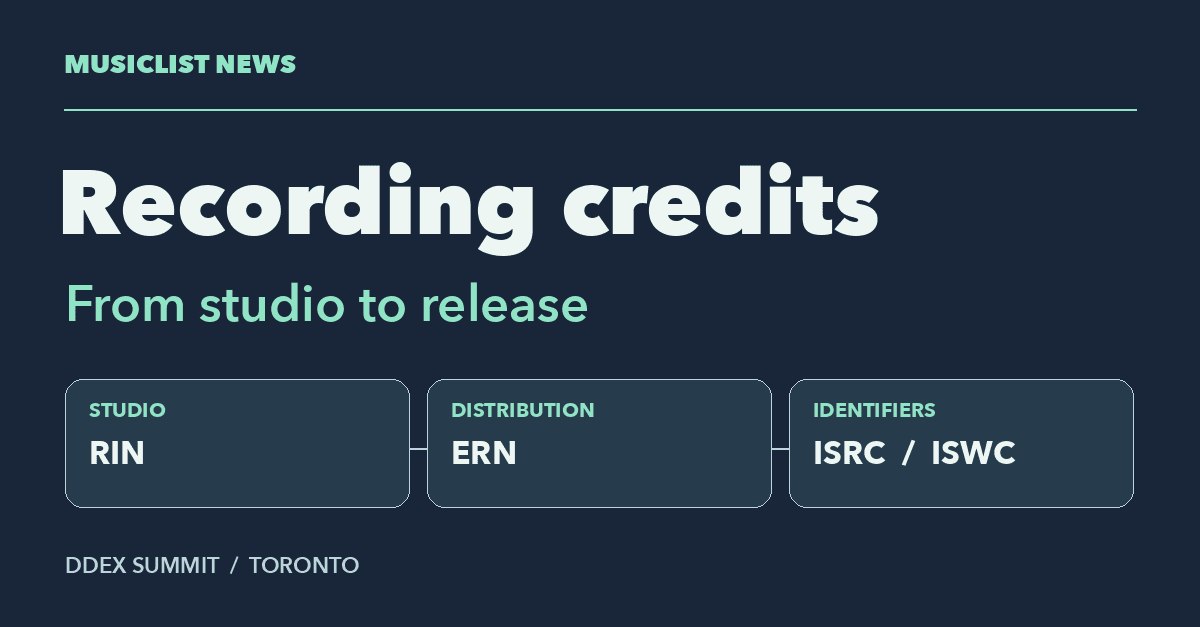
What travels from the studio to the platform
DDEX develops standards that let music companies exchange information in a common format. Its Recording Information Notification standard, or RIN, is designed to carry details from recording sessions, including who contributed and in what role. Its Electronic Release Notification standard, or ERN, covers information a label or distributor can send to a service about the release, its tracks and when and where it can be made available. Those standards do different work along the same route.[3][4]
Independent artists can start with whatever credit fields their distributor supports and a complete record of their own. You can write down the engineer, musician or producer at the session, before a release form narrows what you can enter. MétaMusique’s Québec recording guide includes fields for the studio, session dates, featured and accompanying performers, and technical roles. Ask your distributor which of those roles it can actually deliver for the release.[5][3]
One composition can have several recordings
Imagine you release a single and later put out a live version of the same song. Keep one record for the composition and separate recording entries for the two performances, each with its own ISRC. The ISRC identifies a particular recording. The ISWC, when assigned, identifies the underlying musical work. Keep the composer and lyricist information with the work, and list who played, produced, recorded or mixed each performance under the recording they worked on.[5][3][6]
For a team using SOCAN, check the composition in the work catalogue too. SOCAN’s guide shows how to search by title, contributor or identifiers and how to distinguish a draft from a completed registration. Compare the work record with your agreed writer shares. Then use your recording sheet to compare the credits sent to the distributor. Those two records can need different corrections.[6][5]
A check to run after release
Audit one track before you change your entire catalogue. Use the public track, your distributor’s submission and your own recording sheet side by side. Look for a missing role, a contributor credited on the wrong version or a name that was entered differently across records. Spotify directs artists to their label or distributor to resend corrected metadata, and notes that some distributors do not support credits yet.[7]
Before upload, keep the final titles, recording versions, ISRCs and contributor roles in one shared sheet. Add composition identifiers as they become available.[5][3]
When a credit is wrong, send your distributor the track link, ISRC, exact contributor name and role, and ask whether it can redeliver the corrected field.[7][5]
Save the correction date and check the public credit again. If the error is in the work registration, follow the work administrator’s correction process separately.[7][6]
MusicList
Your music belongs here.
Artists, musicians and music-industry professionals: claim your free profile to unlock smartlinks, a shareable press kit, and direct booking inquiries.
Find my profile